How to Choose a Top China OSB Manufacturer?
Choosing a reliable China Osb Manufacturer requires more than comparing prices on a product page. Buyers should examine production experience, panel quality, testing systems, and communication habits. A professional supplier can explain strand size, resin type, board density, thickness tolerance, and moisture resistance without vague promises. Ask for recent test reports, production photos, and clear information about formaldehyde emissions. A polished website proves little.
Factory verification reveals practical details. Look for clean storage areas, covered raw materials, calibrated presses, and organized quality-control records. During a video inspection or site visit, observe how panels are sampled, labeled, and stacked. Experienced manufacturers should provide traceability from timber sourcing to final packaging. They should also understand destination-market standards and prepare accurate technical documents. Certifications matter, but their scope and validity deserve careful checking.
A capable China Osb Manufacturer will discuss common defects honestly, including edge swelling, uneven density, or surface damage during transport. That honesty builds more trust than perfect claims. No factory is perfect. I have learned that the cheapest quotation can become expensive after rework, delays, or rejected containers. Compare complete costs, not only the board price. Review sample performance, packaging strength, lead times, payment terms, and after-sales support before making a decision. Reliable cooperation develops through measured tests, written specifications, and consistent communication. This guide explains the questions, evidence, and warning signs that help buyers choose with greater confidence.
Define Product Requirements: OSB/3 and OSB/4 Classes Under EN 300
Choosing a top China OSB manufacturer starts with a precise product requirement under EN 300. OSB/3 is designed for load-bearing use in humid conditions, while OSB/4 supports heavier loads under similar exposure. The class is not a marketing label. It should match your project’s span, fixing method, moisture level, and structural calculations.
Ask the manufacturer for current EN 300 test reports from an independent laboratory. Check bending strength, internal bond, thickness swelling, and dimensional tolerance. A reliable supplier should explain which production controls support these figures. Request samples in the exact thickness and edge profile you need. Inspect the surface for loose strands, resin spots, damaged edges, and uneven pressing. Small defects can become installation problems.
Factory evidence matters. Review moisture control, press temperature records, batch traceability, and packaging for ocean transport. Ask how OSB/3 and OSB/4 are separated during storage. Confusion here is surprisingly possible. Also confirm formaldehyde performance, adhesive information, and applicable destination requirements. Documents should identify the tested product, not merely show a generic certificate.
Do not judge quality from a clean showroom sample. Compare three production batches if possible. One sample may look excellent, yet thickness swelling can vary after repeated humidity exposure. I would also question unusually low prices, because reduced resin or weaker process control may affect durability. A careful manufacturer welcomes technical questions, admits process limits, and provides corrective-action records when results fall short.
Compare Strength Data: MOR, MOE, and Thickness Tolerances by EN 300
How to Choose a Top China OSB Manufacturer?
Strength data should lead the supplier comparison. EN 300:2006 separates OSB performance by board type, thickness, and loading direction. For commonly specified OSB/3 panels, benchmark values are about 18 MPa MOR and 3,500 MPa MOE along the major axis. Minor-axis targets are approximately 9 MPa and 1,400 MPa. These figures are not interchangeable. A supplier quoting only one direction leaves an important gap.
Ask for accredited laboratory reports, not factory brochures. Each report should identify board thickness, conditioning method, sampling date, and test direction. For example, an 18 mm panel may show acceptable MOR but weak MOE variation between batches. That difference matters under repeated loading. EN 300 also requires dimensional control, while EN 12872 is commonly referenced for panel tolerances. A practical review should compare measured thickness with the declared value, including edge and center readings. A 1 mm deviation can affect joints, flooring levels, and fastener seating. Small detail. Expensive correction.
Tips: Request three recent production batches. Check both major and minor-axis results. Compare the reported average with the minimum EN 300 requirement. Also examine the worst result, not only the attractive average. FAO’s Global Forest Products Facts and Figures 2023 and the European Panel Federation Annual Report 2023 show the scale and volatility of wood-based panel markets. Yet market reputation cannot replace test evidence. I would still question one perfect report. Real production is rarely perfect.
How to Choose a Top China OSB Manufacturer? - Compare Strength Data: MOR, MOE, and Thickness Tolerances by EN 300
EN 300 Mechanical Performance Comparison for OSB Panels
| OSB Class |
Typical Application |
MOR
Major Axis
(N/mm², minimum) |
MOR
Minor Axis
(N/mm², minimum) |
MOE
Major Axis
(N/mm², minimum) |
MOE
Minor Axis
(N/mm², minimum) |
Moisture Condition |
Manufacturer Data to Request |
| OSB/1 |
General-purpose dry-use panels for non-structural applications |
20 |
10 |
3,500 |
1,400 |
Dry conditions |
Independent test report showing the declared MOR and MOE values by panel direction |
| OSB/2 |
Load-bearing panels for use in dry conditions |
20 |
10 |
3,500 |
1,400 |
Dry conditions |
Production-batch test records, density profile, and formaldehyde-emission documentation |
| OSB/3 |
Load-bearing panels for use in humid conditions |
22 |
11 |
3,500 |
1,400 |
Humid conditions |
MOR, MOE, thickness swelling, internal bond, and moisture-resistance test results |
| OSB/4 |
Heavy-duty load-bearing panels for use in humid conditions |
30 |
15 |
4,800 |
1,900 |
Humid conditions |
Third-party certification, continuous quality-control records, and test results from the proposed production line |
EN 300 Thickness Tolerance Reference
Permitted Thickness Variation by Nominal Panel Thickness
| Nominal Thickness Range |
Permitted Thickness Tolerance |
Example of Acceptable Measured Thickness |
Recommended Incoming Inspection |
| Up to and including 6 mm |
±0.3 mm |
5.7–6.3 mm for a 6 mm panel |
Measure at several points away from edges and compare with the declared nominal thickness |
| Over 6 mm to 10 mm |
±0.5 mm |
9.5–10.5 mm for a 10 mm panel |
Check thickness uniformity across the full panel area |
| Over 10 mm to 19 mm |
±0.7 mm |
17.3–18.7 mm for an 18 mm panel |
Use a calibrated micrometer and record the maximum and minimum readings |
| Over 19 mm to 25 mm |
±0.8 mm |
24.2–25.8 mm for a 25 mm panel |
Verify thickness after conditioning the panels in the agreed test environment |
| Over 25 mm to 30 mm |
±1.0 mm |
29.0–31.0 mm for a 30 mm panel |
Confirm that the tolerance is suitable for the intended joints, fixings, and machining process |
| Over 30 mm to 40 mm |
±1.1 mm |
38.9–41.1 mm for a 40 mm panel |
Include dimensional inspection in the purchase specification and pre-shipment inspection |
How to compare manufacturers: Treat the values above as EN 300 classification benchmarks, not as performance claims for any individual supplier. Ask each shortlisted manufacturer to provide test results identifying the panel class, nominal thickness, test direction, conditioning method, test date, batch number, and laboratory. MOR means modulus of rupture, while MOE means modulus of elasticity. Major-axis values are normally higher than minor-axis values because they follow the principal orientation of the strands.
Reference basis: EN 300 requirements for oriented strand boards. Always confirm the applicable edition of the standard, declared product class, contractual tolerance, and project-specific structural requirements before purchase.
Verify Formaldehyde Emissions: ≤0.09 ppm Under TSCA Title VI
How to Choose a Top China OSB Manufacturer?
Formaldehyde control should be checked before price, capacity, or surface appearance. For OSB, ask for test evidence showing emissions at or below 0.09 ppm under TSCA Title VI. A serious manufacturer should provide reports from a qualified, independent laboratory. The report should identify the OSB thickness, production batch, test method, and sampling date. Generic certificates are weak evidence. Details matter.
Visit the factory, if possible. Watch how wood strands, resin, and pressing temperatures are controlled. Clean storage areas and sealed sample bags can reveal more than polished brochures. Ask whether routine production batches are tested, not only samples prepared for customers. Keep records of lot numbers and shipment dates. This creates traceability when questions appear later.
Do not rely on one document.
A reliable supplier should explain its quality system in clear language. Request recent emission results and compare them with the declared ≤0.09 ppm requirement. Check whether the laboratory scope covers the relevant test. A certificate may be genuine but outdated, incomplete, or unrelated to your panel specification. I have found that missing thickness information can create unnecessary uncertainty. It is a small detail, yet it changes how confidently the result can be applied. Ask practical questions, and leave room for re-testing when materials or resin formulations change.
Assess Factory Capability: Press Size, Annual Output, and Batch Traceability
How to Choose a Top China OSB Manufacturer?
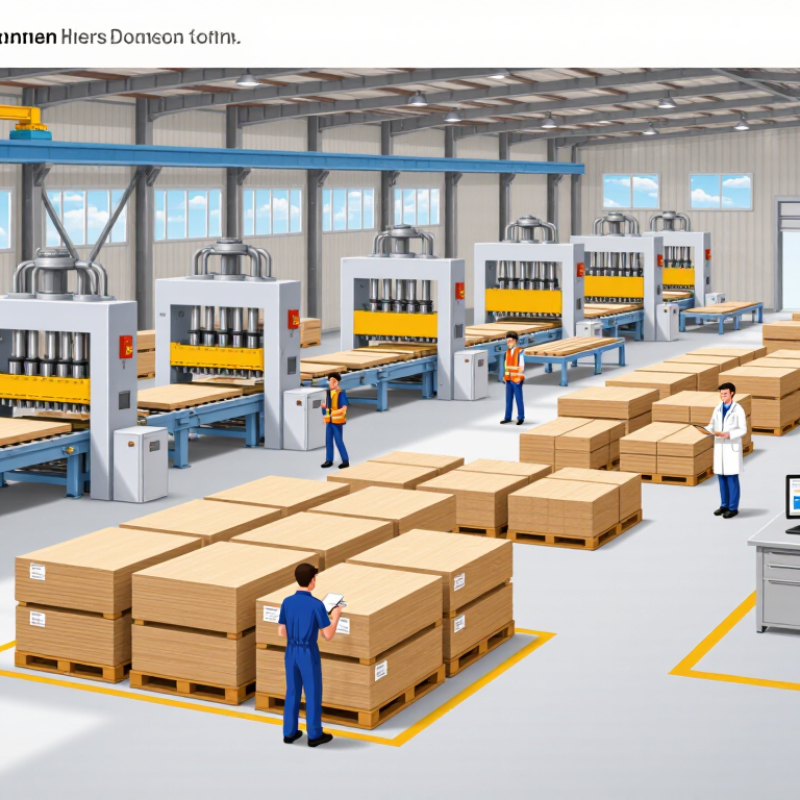
Choosing a top China OSB manufacturer requires more than checking product photos or quoted prices. Factory capability begins with the press. Ask for platen dimensions, pressing pressure, temperature control, and the thickest stable panel size. A large press does not automatically mean better boards. It must maintain even pressure across the entire surface. During a factory visit, inspect panel edges, core alignment, and calibration records beside the production line. Small variations often reveal larger process weaknesses.
Annual output should be measured against real equipment and working shifts. Request production figures for the previous twelve months, not only designed capacity. Compare kiln schedules, resin preparation, sanding lines, and warehouse space with the claimed volume. If one line serves every order, peak-season delays may affect delivery consistency. Ask how rejected panels are recorded and separated. A reliable manufacturer can explain downtime, maintenance intervals, and yield losses without vague promises. That honesty matters.
Batch traceability is equally important. Each pallet should connect to a production date, press line, raw-material lot, and quality inspection record. Test reports should identify thickness, density, moisture, bonding performance, and formaldehyde results where applicable. Use the pallet label as a practical test. Can staff locate its core materials within minutes? Even strong systems may miss one transfer step. That gap deserves attention before placing a large order.
Validate Compliance: FSC Chain of Custody, ISO 9001, and Test Reports
Choosing a top China OSB manufacturer requires more than comparing prices and surface quality. Compliance documents reveal how consistently a factory manages materials and production. During supplier evaluations, I check whether the FSC Chain of Custody certificate covers the actual manufacturing site. A certificate linked only to an office is not enough. Ask for the certificate number, scope, expiry date, and approved product categories.
ISO 9001 can show a working quality system, but it does not guarantee perfect OSB panels. Review the audit scope and recent corrective actions. Ask how the factory controls resin mixing, panel thickness, moisture, and pressing temperature. A serious manufacturer should provide batch records and explain what happens after a failed inspection. Vague answers are warning signs.
Test reports should come from competent, independent laboratories. Check the tested product, production date, sample thickness, and applicable standard. Useful results may cover formaldehyde emissions, bending strength, internal bonding, and moisture resistance. Compare the report with your required specifications, not just attractive numbers. I once trusted an old report too quickly; that was a mistake. Testing must match current production. Request fresh samples and verify that factory labels, batch codes, and report details correspond. Small mismatches deserve careful questions.
How to Choose a Top China OSB Manufacturer?
Validate Compliance: FSC Chain of Custody, ISO 9001, and Test Reports
FSC Chain of Custody certificates are typically issued for cycles of up to five years with annual surveillance. ISO 9001 certification commonly follows a three-year cycle with annual surveillance audits. Test reports do not have a universal expiration period; buyers should verify the test date, applicable standard, product identity, and laboratory credentials for each shipment or product specification.